
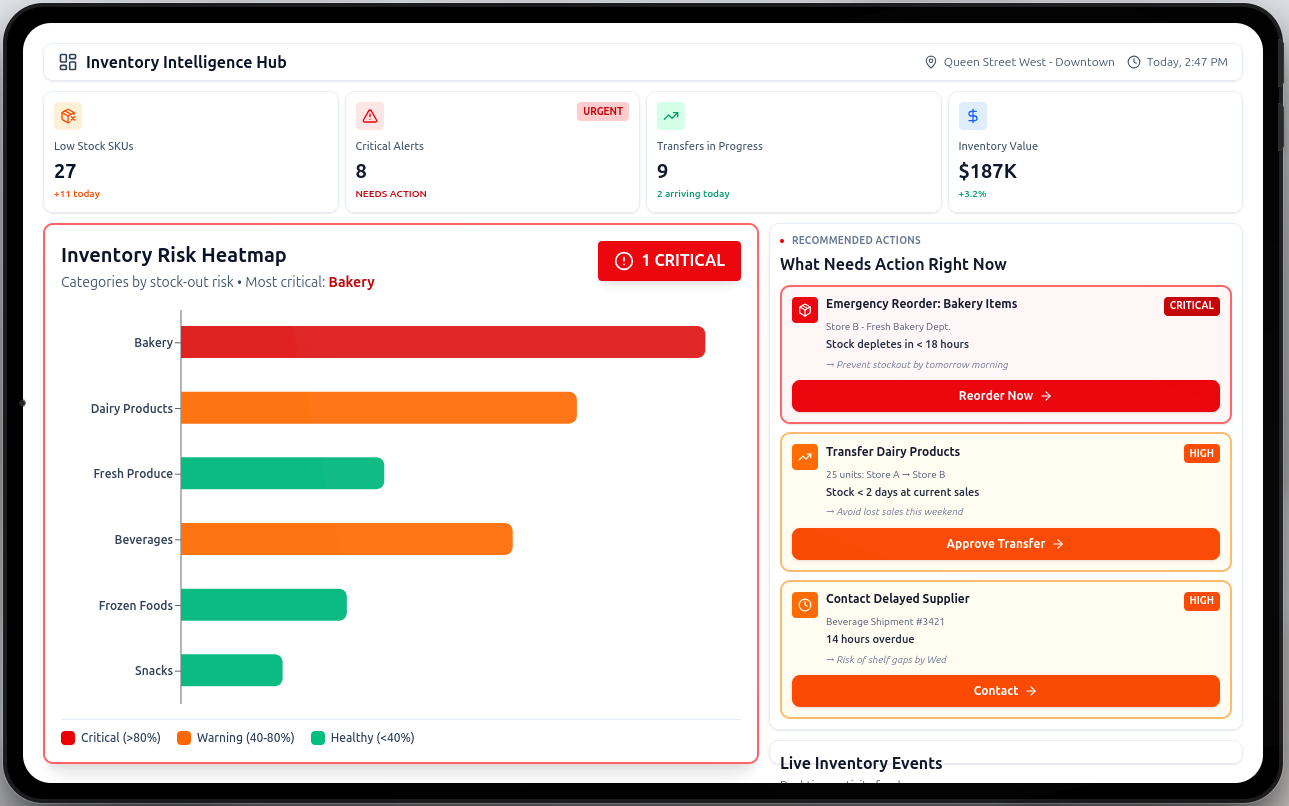
A retail operations dashboard built to help store managers monitor stock health, identify urgent inventory risks, and take action in time. The project focused on turning scattered inventory signals from NetSuite POS into a single, structured, tablet-friendly decision view.
Role
Consultant, BI Developer & Designer
Tech Stack
Power BI, DAX, SQL, NetSuite POS
Duration
3 Weeks
Year
2024
The Challenge
The retail team had access to inventory data but no structured way to act on it. Stock issues were discovered too late, decisions depended on tribal knowledge, and managers were spending significant time checking systems that were not designed to support fast operational decisions.
The Solution
Inventory Intelligence Hub was built as a centralized reporting and decision-support layer on top of the client's existing NetSuite POS data. Rather than replacing their systems, the goal was to surface what already existed in a structured, actionable format.
The solution shifts store managers from reactive stock checks to structured monitoring. Instead of logging into multiple systems or waiting for weekly reports, managers get a single tablet-friendly view that shows them exactly where attention is needed and why.
Every panel and metric was mapped to a specific operational question a manager would ask during their shift. The dashboard was designed around the decisions people actually make, not around the data that happened to be available.
The Dashboard
The main view surfaces the most critical inventory signals immediately — low stock counts, urgent alerts, transfers in progress, and the inventory risk heatmap by category. Recommended actions appear alongside with clear priority levels so managers know exactly what to do next.
The Approach
What Was Built
My Contribution
This project was led end-to-end from the business analysis side. My focus was on understanding the operational context first, then translating that into a reporting structure that made sense for the people who would actually use it daily.
The Impact
Takeaway
Inventory Intelligence Hub is a good example of what happens when you start with the operational question rather than the data. Retail environments generate a lot of inventory signals, but without structure those signals stay as noise. The real work here was translating scattered stock information into a format that made the next decision obvious. That is the kind of outcome business analysis, done well, consistently produces.
Work Together
If your team is making decisions from scattered reports or reactive stock checks, there is a better way. Let's talk about what a structured decision-support layer could look like for your operations.
Let's Talk